So viele Farben Schwarz - Soundinstallation
So viele Farben Schwarz - Soundinstallation
The idea of an autopoietic music automaton had already fascinated the most diverse theoreticians and philosophers throughout human history. The concept is grounded in a very early understanding of the close connection between musical and mathematical structure: From the Ancient Greeks, who were able at an early stage to tell of the close relationship between music and mathematics and hence created fertile soil for the rational derivation and creation of music, via countless medieval scholars, foremost of them Athanasius Kircher, who with the Arca Musarithmica presented a table according to which singers could compose hymns spontaneously by means of new combinatorics, through to contemporary attempts at automated composition such as are being researched at the Institute of Biomimetics at the University of Malaga, for example. Their common feature is the conviction that if one can analyse music mathematically, it must also be possible, by implication, to generate music out of mathematical structures. The piano is the best possible instrument for this: The keyboard unfolds the tonal spectrum analytically and, with the regular succession of white and black keys, expresses the mathematically founded tonal relationships in octaves. Thus, the Austrian composer Karlheinz Essl also had piano works such as the Lexikon-Sonate composed in real time by a specially programmed algorithm and performed live by a pianist.
In the installation developed by Frank Rossi, So viele Farben Schwarz, the two strands of the confrontation with space, respectively with the performer and with time, are combined in the idea of the automaton, which is able to play music independently of humans, and the idea of the automated composition, of endlessly self-generating music, to form an autopoietic, that is to say, both self-playing and self-composing music machine.
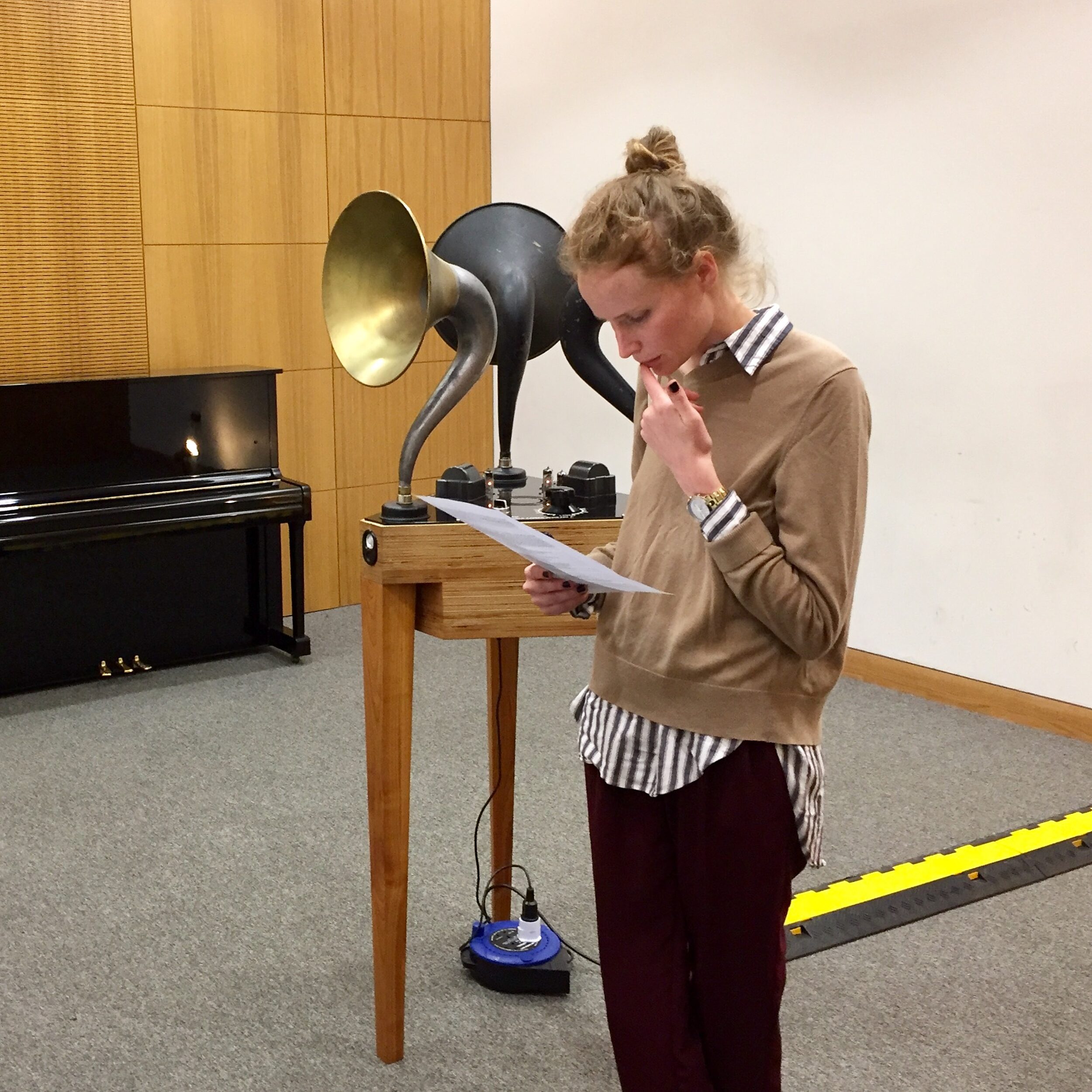
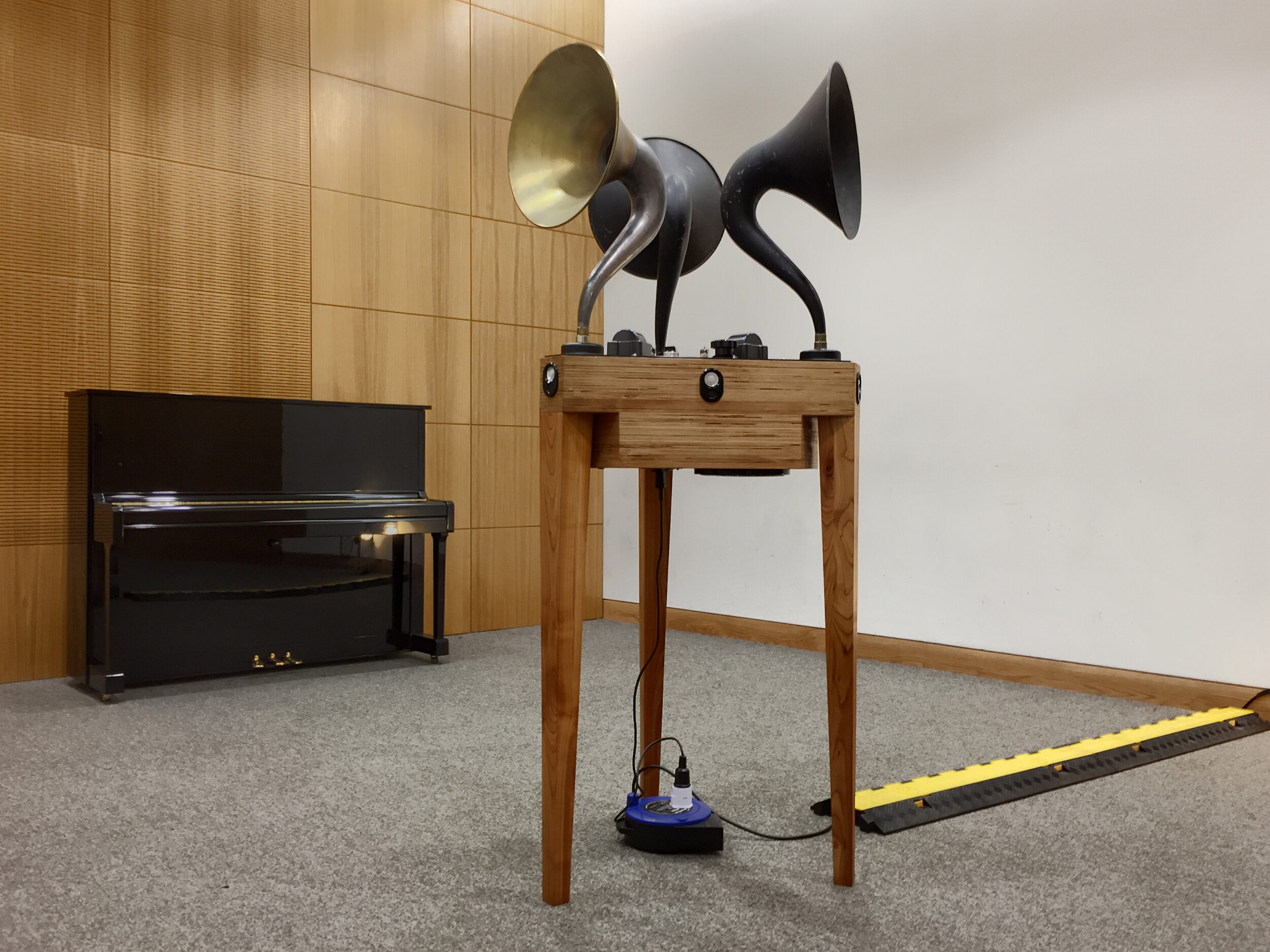
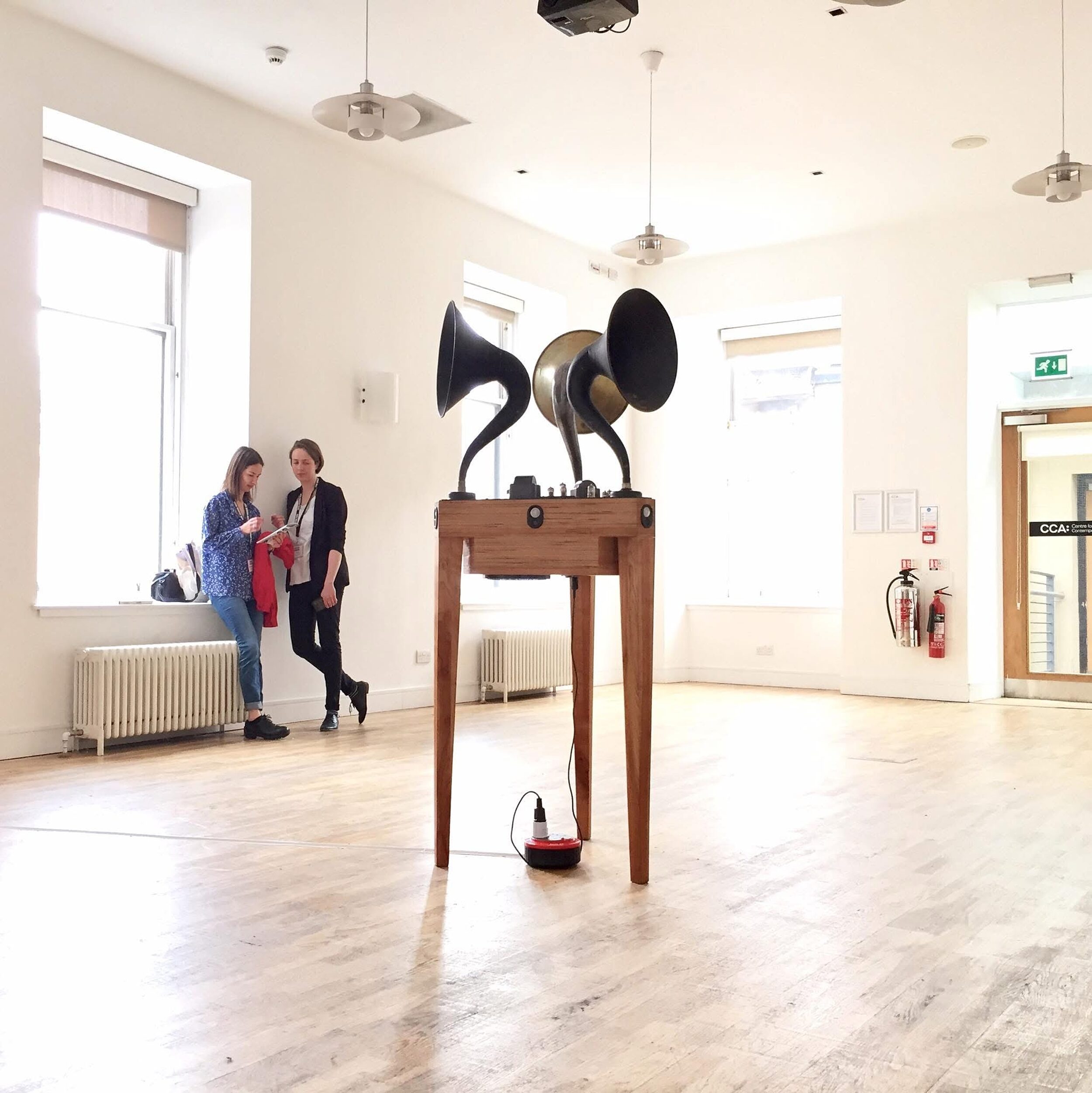
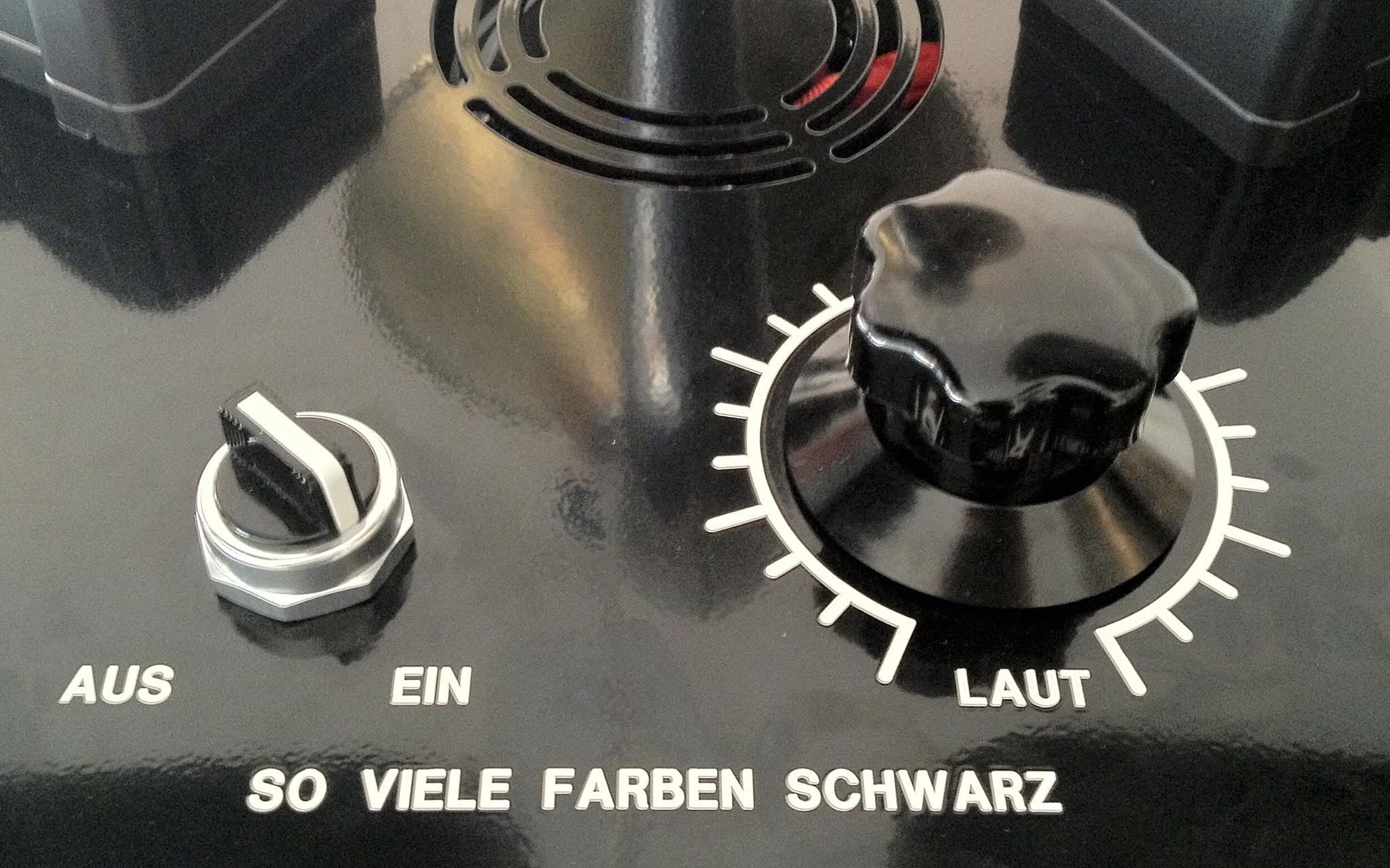
Outwardly, So viele Farben Schwarz resembles a fashionable living-room music box from the 20s/30s, unusually realised as a tripod in a hexagonal shape with three historical gramophone trumpets, directed towards each leg side. The body consists of coated multiplex panels. Visible tube amplifiers, industrial switch levers and the name of the installation, engraved in aluminium, reinforce the impression of a premium product. A cellular automaton installed in the interior generates a continuous, never-repeating music piece, which can be controlled via the six ultrasonic and infrared sensors attached to the outer edges. Movements or an approach towards the installation speed up the pieces playback and intensify the keystroke dynamics. The warm sound, the high sound quality, along with the dynamically richly faceted playing of the piano may give rise to the assumption that intentional piano-playing is at hand here: is the automaton merely playing back a recording of a famous pianist? The possibility of the beholders interaction with the music opens up a game that could increasingly question fixation.
How does the endless piano piece come about? Is it really infinite? One can imagine a cellular automaton in the form of a quadratic grid with equally distributed cells, which represent the individual pitches. One run-through (from left to right) is a generation. There are living cells (sounding tone) and dead cells (silence). These are computed simultaneously and replace the current generation. Previously established rules determine which cells resound in the next generation. Whether a cell is living or dead is ascertained solely from the state of the neighbouring cells of the current generation. An example: A dead cell with precisely three living neighbours will be reborn in the successive generation. A handful of carefully selected rules therefore give rise to an exciting play of constantly self-recreating sound structures. In actual fact it does come to an end at some point, when all the elements die. However, the automaton is so programmed that it begins anew again. While the automaton is running, phenomena such as so-called gliders or oscillators can come about: the latter come about if, on account of the set rules, a small number of cells remain in constant alternation between two states, which has the consequence of a continuous repetition of musical content. The gliders, on the other hand, are a closed bundle of cells that quite literally glide repeatedly right across the cellular automatons grid. The phenomenon is discernible during listening by a small, recurring musical motif. In supplement to the cellular automaton Rossi programmed a „harmonic“ algorithm, which converts combinations of notes into chord structures by means of an allocation logic. There thus arises a mix of tonal and dodecaphonic chord and melody structures, which could lead many a listener to infer the most advanced musical performance.